How windbreaks, evergreen and deciduous hedging affect a spring bulb bed, and how close tulips and other bulbs can be planted to a hedge.
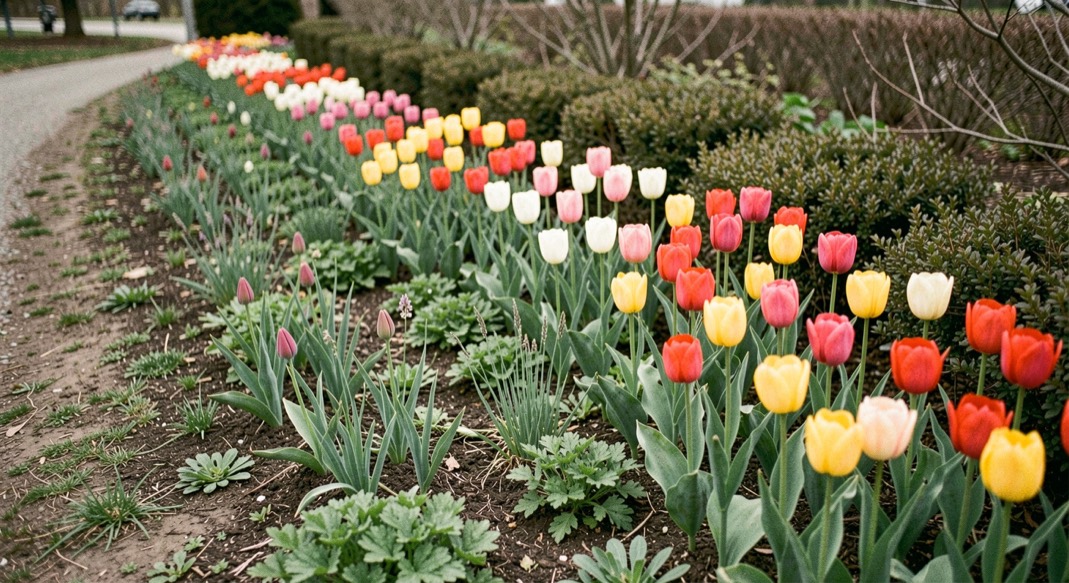
A tulip bed benefits from shelter, but it does not need a solid wall of green around it. A permeable windbreak that slows the wind without stopping it is enough to protect leaves and flowers from scorching and from being rocked loose in the soil. What matters more than the presence of a hedge is its distance, its density and whether it is evergreen or deciduous.
Does a tulip bed need a windbreak?
In exposed gardens, yes. Tulip stems are brittle at the neck, and a bed on open ground in a windy district will show torn foliage, snapped heads and flowers that open and shatter early. Wind also dries the surface soil quickly, so bulbs in a windy bed come out of winter with less moisture than the same bulbs behind shelter.
A windbreak does not have to be a hedge. A low fence, a slatted screen or a line of tall perennials will take the worst of the gust. The useful principle is permeability: a barrier that lets perhaps half the wind through reduces turbulence on the leeward side, while a solid barrier creates a still pocket followed by a violent eddy that can do more damage than open ground. A clipped hedge of moderate density behaves like the permeable screen.
Shelter is most valuable in two windows. The first is late winter and early spring, when leaves are expanding and late frosts still occur. The second is the fortnight around flowering, when petals are at their most fragile. A bed that is sheltered from the prevailing wind but open to the south or west will warm earlier and flower a little ahead of an exposed one.
Gardeners looking at the wider structure of a plot, including the evergreen and deciduous planting that carries it through winter, may find the French-language notes at evergreen oak and hedgerow a useful reference for how a hedge behaves as a windbreak and how its height and form change the shelter it gives.
Evergreen hedge or deciduous hedge beside spring bulbs?
Both work, and they do different jobs.
An evergreen hedge gives shelter in winter and early spring, exactly when a bulb bed is most exposed. It also holds a green backdrop behind the flowers, which suits pale tulips and small early varieties. The cost is root competition and shade. Evergreen roots are active through the winter, and a dense evergreen canopy casts a shadow that lasts from autumn into spring, so the soil behind it stays colder and the bulbs emerge later.
A deciduous hedge is bare when the bulbs are growing. Light reaches the bed from February onwards, the soil warms sooner and the leaves dry faster after rain, which reduces botrytis. The trade-off is that the same hedge offers almost no shelter in the months when wind and frost do the most damage. It also leafs up in late spring, just as tulip foliage is ripening, and the new shade can slow that ripening.
A mixed hedge, or an evergreen hedge with a deciduous component, is a common compromise. It keeps some winter cover, opens up in early spring and gives the bed a changing backdrop rather than a flat one. Where the bed is small, a single evergreen shrub at the windward end is often enough.
How close to a hedge can bulbs be planted?
Distance is a question of roots and shade rather than of the bulbs themselves. As a working rule, plant no closer than the hedge's own root spread, which for a mature hedge is roughly the height of the hedge. A two-metre hedge will have roots reaching about two metres, and a bulb bed inside that zone will be competing for water and nutrients.
A practical minimum for most gardens is 60 to 90 cm from the hedge line for small bulbs, and 90 cm to 1.2 m for tulips and other large-flowered types. This keeps the bulbs outside the densest mat of surface roots, allows air to move between hedge and bed, and leaves room to work the soil without cutting roots.
Shade matters as much as roots. A bed on the north side of an evergreen hedge may lose direct sun for much of the day, and tulips in particular want full sun during leaf expansion. A bed on the south or east side of the same hedge will be warmer and drier, and bulbs there usually perform better. If the only space available is close to the hedge, choose early, short varieties and accept that they will be smaller.
Where a hedge is being planted or replaced, it is worth setting the bulb bed first and the hedge afterwards, so the planting distance can be measured from the bulbs rather than adjusted around an established root system.
What a garden keeps green through winter
The winter garden is carried by structure rather than by flowers. Evergreen hedges, clipped or informal, provide the frame; evergreen shrubs and small trees fill the middle distance; and the ground itself, if it is not bare, is held by low evergreen cover or by the dead standing stems of perennials left for seed heads and insects.
Bulbs contribute little to this picture between November and February. Their leaves are gone or not yet up, and the bed reads as bare soil. That is not a fault. It is the reason a bulb bed benefits from being set against something that does stay green, so the space is not empty for half the year. A hedge behind the bed, an evergreen shrub at one end or a low evergreen edging along the front all serve this purpose.
Winter structure also affects how the bed dries. An evergreen hedge that blocks the low winter sun will keep the soil colder and wetter, which suits some bulbs and not others. Tulips prefer a well-drained soil that dries in summer, and a bed that stays damp under a hedge is a poor site for them. The same damp shade is tolerated by snowdrops, winter aconites and some narcissus.
Shelter, shade and the limits of a hedge
A hedge is not a solution on its own. It changes wind, light, temperature and moisture, and each of those changes has a consequence for the bulbs behind it. The useful approach is to decide what the bed needs most: shelter from wind, light in early spring, or dry soil in summer. A permeable hedge at a sensible distance can supply the first without taking too much of the second, and a free-draining bed can supply the third.
Where the site is coastal, salt carried in the wind adds another factor. Evergreen hedges that tolerate exposure are usually the ones that also tolerate salt, and they are worth choosing for that reason alone. Inland, the same hedge may be chosen for privacy or for a background, and the bulb bed can then be planned around it.
Records kept over several seasons are more useful than any single rule. The date the first leaves break, the date the bed dries after rain, the direction of the worst wind and the point at which the hedge casts its shadow are all observations that can be written down and compared. They will say more about a particular garden than a general recommendation can.
Shelter planting and winter greenery come from the same conifers, so the material cut for a windbreak or hedge has a second use once the bulbs are dormant. The conifer trimmings taken when a hedge is tidied can be wired into rings and ropes rather than composted, and the notes on evergreen wreaths in winter describe how a fresh wreath is built, how noble fir compares with a mixed wreath, and how much garland a door, mantel or stair rail needs. Both pages share one subject: what evergreen material does, in the ground and indoors.
Continue the reading
Compare planting guide, aftercare guide and source method.