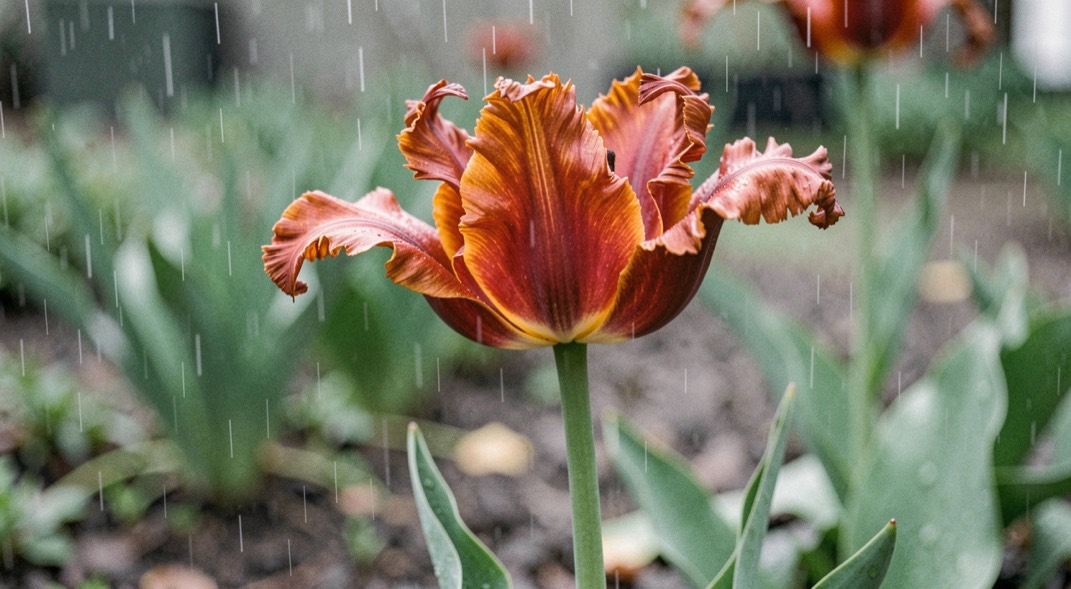
Parrot tulips are read through movement: curled petals, irregular edges and a flower that can change shape as it opens. Their drama is real, but it needs enough space and a little weather humility.
A form that moves
The petals can twist, flare and catch rain differently from a simple cup. Photographing the whole stem and the surrounding leaves keeps the record grounded in a plant rather than a single spectacular close-up.
The form is not a durability score. Wind, rain and the weight of the flower can change the display even when the cultivar name is correct.
Give the flower a stage
Plant a ruffled form where the outline can be seen against a calmer background. Pair it with simple cups or foliage rather than another flower that competes for the same irregular edge.
The Double Late tulips guide offers a useful late-season comparison, while colour wording keeps the palette from becoming a catalogue of adjectives.
Weather is part of the note
A trial record can tell a reader what happened under named conditions. It cannot promise that a petal will hold through every spring storm. The RHS trial record and methodology keep that scale visible.
For a source correction, write to the correction desk.
Continue the reading
Compare Black Parrot record, Double Late and garden plan.
A note from another craft
Reading an irregular shape against a quiet background is not only a horticultural habit: Möbelbau aus Holz is kept here as the German-language counterpart for readers who also build the bench the border is seen from, and the group guide places the parrot form among the other divisions.