How to plant bulbs where summers are dry, what a plot's soil and planting reveal before a purchase, and which plants carry a dry garden between bulb seasons.
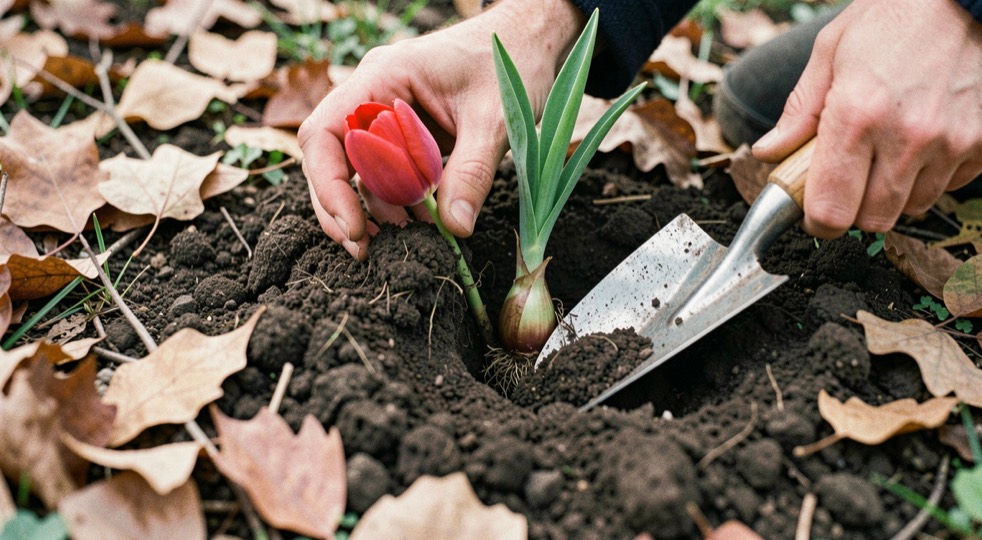
A dry plot is read from the ground up: the soil tells you how water behaves, the planting tells you what has already survived there, and the bulbs tell you what the garden does in its quiet months. Get the water and the soil right first, and bulbs will follow; get them wrong, and no amount of spring colour will hold. The same evidence that guides planting also guides a buyer, long before anything new goes in.
Start with the soil and the water
Where summers are dry, the limiting factor is rarely the bulb itself. It is the soil's capacity to hold winter and spring moisture, then drain before the dormant season. A bulb planted in heavy clay that stays wet through July will rot; the same bulb in thin, fast-draining ground will simply dry out unless it is given depth and a little organic matter to work with.
The practical sequence is straightforward. Plant at two to three times the bulb's own depth, deeper in sandy ground and shallower in clay. Work in well-rotted organic matter to improve structure rather than to feed. Mulch after planting to slow surface evaporation, but keep the mulch clear of the emerging shoot. Water at planting to settle the soil, then rely on winter and spring rain where it comes; in a dry autumn, one deep watering is worth more than several light ones.
This is the same reading of ground that a buyer is asked to do. Soil, slope, aspect and existing planting are the record of how a plot handles water, and they are visible before a single new bulb is lifted. A garden that has been planted for its conditions, rather than against them, shows it. That principle runs through the way a dry-climate garden is assessed in places such as Rancho Santa Fe garden plots, where the local editorial record treats soil, aspect and planting as evidence in its own right.
How do you plant bulbs where summers are dry?
Plant in autumn, once soil temperatures have fallen but before the ground closes, and treat the bulb as a winter and spring tenant rather than a year-round one. The aim is to give it moisture while it is growing and to keep it dry while it is dormant.
Choose species that evolved with a dry summer. Tulipa species and their close relatives, alliums, narcissus, crocus, fritillaria and many irises all follow the same pattern: leaf and flower in the cool months, then retreat. They do not need summer water, and in most dry plots they do better without it.
Prepare the planting pocket rather than the whole bed. A narrow hole, loosened to the depth of a trowel and mixed with a handful of grit in heavy ground, is enough. Set the bulb upright, point up, and firm the soil back without compacting it. Space bulbs so that air moves between them; crowding keeps foliage wet and invites disease.
After planting, mark the position. Dry-ground bulbs disappear completely in dormancy, and a label or a discreet stake prevents the fork from finding them later. If the plot is irrigated for other plants, keep the bulb area on a separate line or a separate valve so that summer water can be withheld.
What does a plot's soil and planting say before a purchase?
A plot's existing planting is a long experiment that someone else has already run. What survives there, and what has been replaced, is evidence about drainage, aspect, wind and water. A buyer can read it in an afternoon.
Look first at the ground itself. Compacted, bare soil with a crust and no worm activity suggests poor structure and slow infiltration. Moss or rushes point to water that sits. Thin, stony ground with drought-tolerant shrubs points to fast drainage and low summer moisture. Neither is a fault; both are information.
Then look at the planting. Mature trees indicate the root zone and the shade they cast, and their species indicate what the site has tolerated for decades. Hedges and shelter belts show prevailing wind. Established dry-garden plants, from lavender and rosemary to cistus and ornamental grasses, show that the plot has been managed for its climate rather than against it.
Finally, look at the water. Irrigation lines, tanks, wells, grey-water systems and the condition of any lawn all describe how much water the garden has needed. A large lawn in a dry district is a statement about maintenance and cost, and it is one of the first things an inspector or an adviser will note.
None of this replaces a survey, an inspection or a title search. It is simply the garden's own record, and it is available before any of those are commissioned.
Which plants carry a dry garden between bulb seasons?
Bulbs are a season, not a scheme. The garden needs a structure that holds when the bulb foliage has yellowed and the ground is bare.
Evergreen shrubs and sub-shrubs do most of that work. Lavender, rosemary, cistus, santolina, teucrium and phlomis are all adapted to dry summers, and they hold shape through the hot months. Mediterranean herbs double as ground cover and as scent near a path.
Ornamental grasses carry the middle of the year. Stipa, miscanthus, festuca and calamagrostis move in wind, tolerate lean soil and need little summer water once established. They also hide the dying foliage of spring bulbs, which is useful when the garden is small.
Structural plants give the plot a frame. Olives, bay, myrtle and dwarf pines are slow but long-lived, and they read as architecture rather than as bedding. In a dry garden, a small number of these does more than a large number of short-lived plants.
For late colour, rely on drought-tolerant perennials: salvia, verbena, gaura, echinops and eryngium. They flower through summer on little water and leave seed heads that hold into winter. Together with the bulbs, they give the plot a sequence rather than a single moment.
Water, mulch and the working routine
Once the planting is right, the routine is mostly about water discipline. Water deeply and less often, so that roots follow moisture downward rather than sitting near the surface. Early morning is the better time, and drip or soaker lines lose less than overhead spray.
Mulch every bed, but match the mulch to the plant. Gravel suits Mediterranean planting and reflects light; compost suits perennials that benefit from improved soil. Keep mulch away from stems and crowns to avoid rot.
Group plants by water need rather than by colour. A single hydrozone for the dry-adapted plants and a separate one for anything thirstier keeps the irrigation honest and the bills predictable.
Finally, keep records. Note what was planted, when it flowered, and what did not return. In a dry garden, the failures are as informative as the successes, and a written record is what turns a plot into a garden that can be managed rather than merely watered.
What the garden shows a buyer
Before anything is planted, a plot already says something. Soil, slope, aspect, existing planting and the water system together describe how the ground behaves and what it will cost to keep. A garden that has been planted for its conditions shows restraint, structure and a realistic water budget. A garden planted against them shows the opposite, and it shows it early.
For anyone assessing a dry plot, the useful habit is the same one a gardener uses: read the ground first, then the planting, then the water. Bulbs, shrubs and grasses are the response to that reading, not a substitute for it.
Dry plots and woodland plots sit at opposite ends of the same question, which is what the soil does with water and light. A reader who has judged a site by its summer surface may still want to know how a shaded floor behaves, and the notes on leaf litter and oak soil set out what oak woodland teaches about structure, leaf mould, shade tolerance and reading the ground before planting. The two pages are companions: one reads a dry plot, the other a wooded one, and both begin with observation rather than purchase.
Continue the reading
Compare planting guide, aftercare guide and source method.